The Sierra Tabasco region is the only place in the world having at least 4,000 years of uninterrupted
production and consumption of cacao. The region’s long history of cacao starts with the mother
culture of Mesoamerica – the Olmecs – an ancient civilization that left residues of theobromine in
3000+ year old vessels. Its central role to Mesoamerican civilization continued with the Mayans,
famous for their use of cacao liquor for ceremonial purposes, which was held in such high esteem
that they called it food of the gods. Mayan wall paintings show kings and gods drinking cacao liquor
and only 90 kilometers from our fermentadora lies the grave of King Pakal, who ruled the temples
of Palenque, with his mother, Sak K’uk, depicted as a cacao tree on the sarcophagus. When Cortes
marched through Tabasco, he wrote to the King of Spain describing a peaceful land with abundant
cacao. With the first beans that crossed the Atlantic Ocean, cacao became Mesoamerica’s gift to the
world.
This intimate history of cacao makes the region a hotspot for cacao diversity and hybridization
between ancient criollo and amelonado cacaos that were brought to the region from the Amazon by
a French family in the beginning of the last century. The unique flavor character of Tabasqueño is
indebted to its dense and diverse terroir and its ancient complex genetic traits.
FROM ANCIENT TO NOWADAYS…
Traditionally, there are 3 main morphotypes: Criollo, Forastero and Trinitario. It is in the Amazon
where the major genetic diversity is concentrated and from where it emigrated to Central America
and South Mexico. Today we know 10 groups.
In the South of Mexico, the first plantations were established by the Mayans under a sophisticated
agroecosystem with several plants associated to cacao. And it was in Chontalpa region in Tabasco
where there was the most extensive area of cacao under the artificial design of a tropical forest. In
this period, the cacao plantations extended from the north of Veracruz to Oaxaca and also to Jalisco,
Michoacán and Colima (Nowadays it is mainly Tabasco and Chiapas, and still some in Oaxaca region).
In Tabasco and Chiapas, the main cacao grown there was a ‘zuchini-shape’ called Patastillo and a
forastero called Ceylan possibly introduced in 1900. Alonso (1984) indicated that 98% of Tabasco
plantations come from seed of 70% Amelonado, 26% Patastillo and 4% Criollo.
It seems that the introduced types were recombined with the ancient criollo populations and
generated a significant genetic diversity in the new plantations. This can be used to increase yield,
quality and sustainability for the region. The current plantations of Tabasco are mainly Trinitarios.
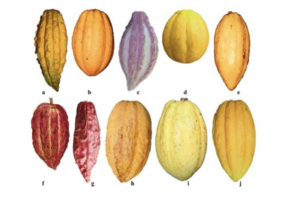
A study has been done in qualitative characterization by Guillermo Ramirez, which allowed to observe
the morphological diversity of cacao pods in specific studied plantations. From the pods observed, it
was found: the dominante was ‘cundeamor’ (>26%), ‘amelonado’ (>20%) and in the germplasm,
‘angoleta’ (>30%). The following image shows the diversity of pods: